

No one knows exactly when West African makers began using stamps in their textile production. But it’s fair to assume the practice developed alongside dyeing itself, particularly resist dyeing. Once indigo and other natural dyes were used to decorate cloth, it makes sense that makers would want to expand their design vocabulary beyond what a brush or hand alone could achieve. Stamps offered a way to do that: to repeat a motif precisely, again and again, across a length of fabric.
Before getting into the stamps themselves, it’s worth being clear about what was actually being stamped on. Historically, the cloth in question was cotton, most often locally grown and hand-spun, then woven on narrow looms into long strips that were sewn together to form a finished piece of cloth, a method commonly known as strip weaving and found across much of West Africa. Imported cotton textiles, brought in through trade, were also used as a surface for stamping and dyeing as they became more widely available.

Fortier, “Tisserand Malinké,” ca. 1920-1930]
A weaver at work on a narrow strip loom, Senegal. Fortier photo, Collection générale de l’AOF.
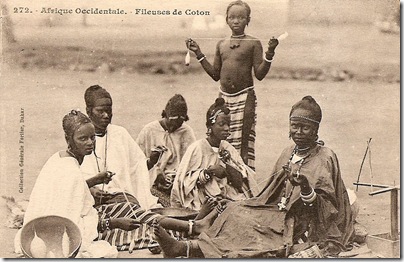
Fortier, “Fileuses de Coton,” Collection générale Fortier, Dakar, no. 272]
Women spinning cotton by hand, French West Africa. Fortier photo, Collection générale de l’AOF.
Across the region, stamps have taken different forms depending on where they were made and what they were made from: carved calabash, carved wood, cut stencils, and now, in many places, foam. Tracing that material evolution says a lot about how these traditions have adapted over time while still holding onto their core techniques.
Calabash Stamps and the Adinkra Cloth of Ghana
In Ghana, the adinkra cloth tradition uses stamps carved from the dried shell of a calabash gourd. Each stamp is carved with a distinct symbol, such as sankofa, gye nyame, and dozens of others, and mounted on a wooden stick for easier handling. The stamps are dipped into adinkra aduro, a thick black ink made by boiling the bark of the badie tree, then pressed onto the cloth in a careful, repeating grid. It’s impossible to talk about the stamp on its own here; the ink is just as central to the tradition, and the two exist as a pair. Calabash stamps and badie-tree ink are still used to make adinkra cloth today, largely unchanged from how they’ve always been made.
 Green Calabash
 Carved Calabash
Wooden Stamps and the Garra Cloth of Sierra Leone
In Sierra Leone, designs have traditionally been carved directly into the surface of wood. These wooden stamps were dipped in dye or paste and pressed onto cloth to create garra cloth (also spelled gara), a name historically associated with indigo dyeing. Over time, the same name, gara, came to be associated with a related but different technique: using wax to resist the dye rather than stamping color directly onto the cloth. It’s difficult to pin down exactly where this shift originated. Resist-dyed archaeological fragments have been found in Mali, which suggests the broader technique existed across the region and likely evolved along parallel, related paths in different places rather than spreading from a single point of origin.
Wooden Tampons and Batik in Mali, Senegal, and Côte d’Ivoire
In Mali, Senegal, Côted’Ivoiree, and other Francophone West African countries, wooden stamps, often called tampons, followed a similar trajectory. Historically, tampons were dipped in a resist substance; eventually, they were dipped in wax instead, using a stamp to apply a wax resist to the cloth before dyeing. This is the technique that produces batik as it’s known and practiced across much of West Africa today.

Stencils and Everyday Tools: Zinc, Combs, and Found Objects
Stencils are often grouped with stamps, but the two work differently. A stamp carries a raised design that is pressed onto the cloth; a stencil is cut, and paste or dye is pushed through the openings to imprint the design. Both achieve a similar goal: repeatable, precise motifs, but through different mechanics.
Stencils have a long history in West African textile production. In Nigeria, adire cloth was historically made using stencils and cassava starch paste, which was pushed through the cut designs onto the fabric before the cloth was dyed in indigo. In Guinea, stencils, some cut from zinc, have long been used to imprint designs onto cloth. Zinc stencils in particular show how the material used could shift even while the underlying method, cutting a design and pushing color through it, stayed the same.
 A cardboard stencil
Beyond stamps and stencils, makers have also relied on a range of everyday and found objects to apply and manipulate paste and dye directly onto cloth. Small combs, whether store-bought or handmade, have been used to draw fine lines and repeated textures into paste by hand. Chicken feathers have served as improvised brushes for finer detail work. Brooms and twigs, simple and readily available, have been used to flick, drag, or drip paste and dye across the fabric in freer, less structured patterns. Even carved calabash combs, an offshoot of the same calabash-carving tradition used for adinkra stamps, have been shaped specifically for combing designs into paste. These tools are a reminder that stamps and stencils were never the whole story; makers have always reached for whatever object, carved or found, could get a particular line or texture onto the cloth.

Broom in wax
The Shift to Foam
More recently, and most relevant to how cloth is made today at Ngande Textiles, foam stamps have become the dominant tool across much of West Africa. No one has a clear record of exactly how or when foam entered the picture, but the shift makes sense in light of everything before it. Foam stamps are, in a way, the newest link in a chain that runs from carved calabash to carved wood to cut stencil: makers experimenting with new materials, in this case discovering that foam holds up better for industrial-scale, repeated use than wood or calabash. Foam is more durable, faster to work with, and holds its shape over longer production runs, all of which matters when a maker is producing cloth at volume rather than one piece at a time.
This is most visible in Nigeria, where adire production has largely shifted from stencils and cassava paste to foam stamps. The pivot wasn’t a break from tradition so much as an adaptation within it: makers experimenting, comparing results, and settling on what worked best for the scale they needed.

What’s Changed, and What Hasn’t
It’s worth being clear about what has actually shifted here and what hasn’t. Calabash stamps are still used to make adinkra cloth in Ghana today, essentially unchanged. Wooden tampons are still used in the countries where they’ve always been used. Combs, feathers, brooms, and twigs are still part of many makers’ everyday toolkits. What has changed is largely concentrated in traditions like adire, where the demands of industrial-scale production pushed makers toward a more durable material.
So while the tools have moved from calabash to wood to stencil to foam, and have always included whatever simple object could do the job, the underlying logic hasn’t changed at all: carve, cut, or shape a tool, apply it with consistency, and let the dye do the rest. Foam is simply the latest material in a very old conversation between makers and their tools, one that, for the most part, has remained remarkably consistent across generations, geography, and material.
Learn More:
1. How to Make an African Batik Stamp
2. Into Indigo: African Textiles and Dyeing Techniques by Claire Polakoff


